


 Other Languages > Where is Palestine headed ? Interview with Khaled Barakat
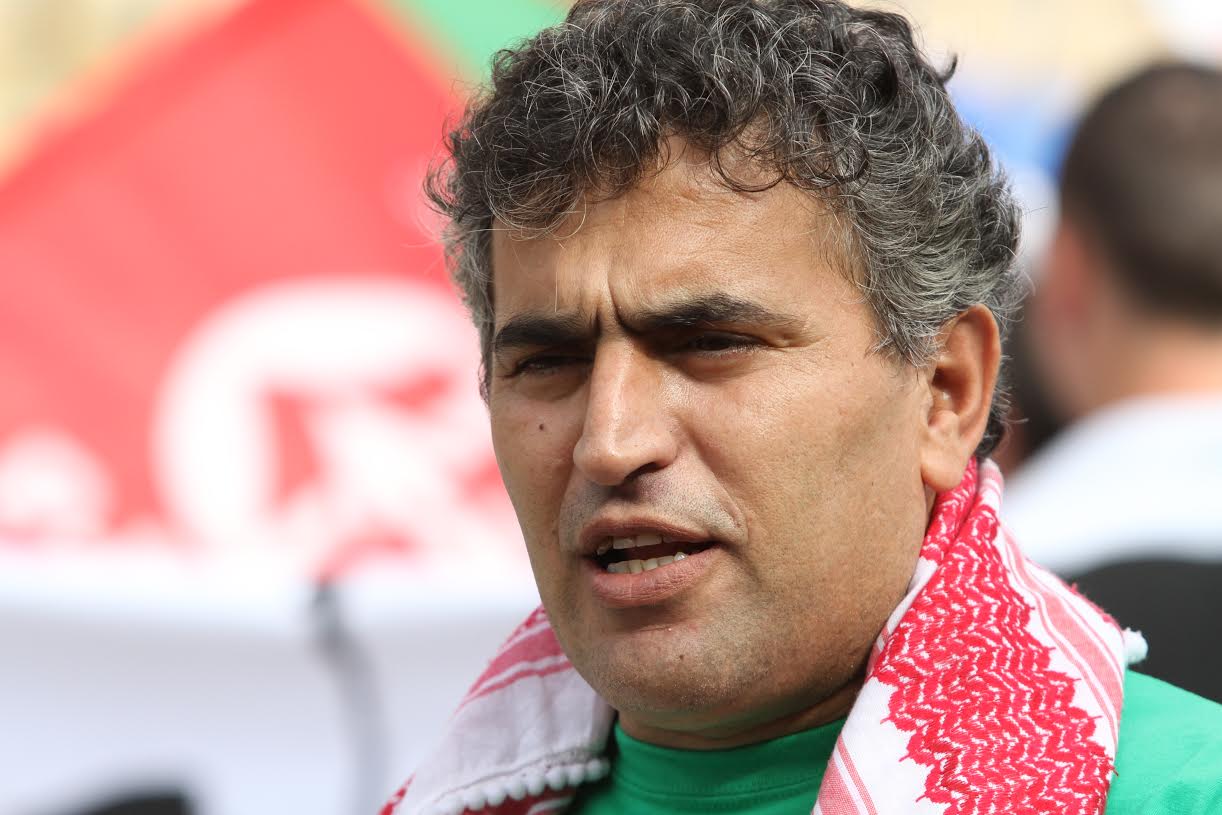
Where is Palestine headed ? Interview with Khaled Barakat
Partisan Magazine N°1 - Janvier 2015
What is the situation in occupied Palestine since the last Zionist attack on Gaza this summer ?
The situation in Palestine after the assault on Gaza is as it always has been. We see ongoing Palestinian resistance to occupation in the West Bank and escalating movements in Jerusalem and in the occupied lands of 1948 (“Israel”). As for our people in Gaza, the siege is continuing ; in fact, it is worse than it has been before the aggression, in an attempt to push Palestinians to make political concessions and undermine the achievements of the people and the resistance in repelling the Zionist assault.
In the last three weeks, we have been witnessing an escalation of popular resistance in Jerusalem and the surrounding areas, as well as the West Bank. Israel has continued its policy of assassinations and targeted killings, including the assassination of Comrade Mohammed Jawabreh, 21 years old, who was shot point-blank by the occupation forces in Al-Arroub refugee camp.
Mass arrest raids continue, and over 6,200 Palestinian political prisoners remain in occupation prisons, and hundreds of those are held without charge or trial in administrative detention. We have seen, alongside the escalating assassinations targeting Palestinian resistance, mass arrest policies that are aimed at suppressing the growing popular uprising. The Palestinian prisoners are leaders in the struggle for Palestine, including the imprisoned PFLP General Secretary, Comrade Ahmad Sa’adat. Former prisoners have been playing a major role in the escalating resistance confronting the occupation soldiers and colonists in the West Bank and Jerusalem, as well.
Politically, there is a lot of talk by the Palestinian Authority about going to the United Nations Security Council in order to define a timeline, as they say, to end the occupation. We do not trust the PA nor do we expect any real results from the UN Security Council. The United States will veto any Palestinian resolution at the Security Council. At the same time, we want to see a higher level of confrontation of the occupation state at all levels, including the official and diplomatic level, and including joining the International Criminal Court to demand the prosecution of Zionist war criminals. This is a clear and necessary alternative to the dangerous and futile path of negotiations, which has provided nothing for the Palestinian people while it provides a cover for ongoing Zionist occupation and racism.
Internally, the contradictions between Fateh and Hamas are continuing. There is an attempt by the United States, Israel and even Egypt to push Palestinians once again into internal conflicts rather than confronting the occupation. The so-called “international community” is also attempting to abuse and manipulate Palestinians through their control over the rebuilding funds for Gaza, and are exploiting the Palestinian situation and the needs of the Palestinian people in an attempt to undermine Palestinian sovereignty and the victories achieved by the resistance on the ground against the occupation armies.
In other words, it is business as usual : occupation continues, resistance continues.
The Popular Front for the Liberation of Palestine is today one of the few organizations left progressive and revolutionary in Palestine. What are its objectives ? What prospects does he defend the Palestinian people ?
The Popular Front for the Liberation of Palestine is one of the few revolutionary left organizations in the Arab world and the region, not only in Palestine. Some people view the Front as “a faction.” We are not a faction – we are a revolutionary political party that has deep historical roots of struggle that go back to 1948. The Front was established officially on December 11, 1967, but it arrived on that day after a very long journey of struggle in the Arab Nationalist Movement, which has a rich and extensive history of struggle in Yemen, Bahrain, Kuwait, Syria, Lebanon, Palestine and Egypt. Therefore, the Front is an Arab revolutionary party with a very clear internationalist identity. The views of the Front on the conflict with the Zionist enemy, “Israel”, and the nature of the enemy that we confront, remain the same : that the Palestinian and Arab people, and the workers and oppressed people of the world, confront imperialism, Zionism and reaction in a struggle for liberation.
Many events and changes have taken place since the establishment of the Front, but the nature of Israel has remained the same, and our people have not achieved their rights, the rights that the Front was established in order to achieve. The imperialist war against the region has not only remained unchanged – it has escalated. And imperialism, Zionism and Arab reactionary regimes have in fact become even more dependent upon their relationships with one another to preserve domination, hegemony and profit. This is the enemy camp which the Palestinian liberation movement confronts, and it has not changed. However, our camp – the camp of the revolution, the socialist camp – suffered a major blow and the left on a global level suffered a severe crisis and faced tremendous and extraordinary challenges, particularly in the late 1980s and the 1990s. But now, we began to see an end of the era of retreat and the beginning of a new period in which the revolutionary left forces are advancing, and will rise.
On Palestine, the Front affirms its commitment to liberating the entire land of Palestine from the river to the sea from the Zionist settler colonial project of “Israel,” and the establishment of a democratic alternative society in which all people in Palestine can live equally, despite their race, religion, sex, gender, colour, or sexual orientation. Such a society can only be established with two conditions : the right of Palestinian refugees to return and the dismantling of the Zionist state. For the Front, and indeed for the Palestinian people – the majority of whom are refugees - the right of return for Palestinian refugees to their original homes and lands is the central issue in the struggle for Palestine.
On the daily, tactical positions of the Front, we are still struggling to rebuild the Palestinian national institutions, on the one hand, and confront the occupation, on the other hand. We face a double task, and these tasks are dialectically related. We cannot achieve victory in the face of the occupation if we do not have a strong internal united front. And we cannot have a strong internal united front without a focus on resistance and confrontation of the occupation. The division in the Palestinian internal politics is not a division between Fateh and Hamas. The real, substantive division, the real conflict, lies between two paths : the path of the Palestinian comprador capitalists who profit from the agreements with the occupier ; and the path of the popular classes, who can only gain their freedom through struggle.
As for Fateh and Hamas, they are struggling to present themselves as the sole legitimate representatives of the Palestinian people. Publicly, Fateh says that the PLO is the sole legitimate representative of the Palestinian people – but in reality, Fateh acts as if it is the PLO – it controls all of the institutions, the embassies, the government and governance structures, finances and security as a near-total monopoly. Looking at Hamas, on the other hand, the social base and fighters of Hamas have their hearts in the right place. The problem is found in certain trends in the leadership of Hamas who are counting on regional powers to be a mediator between the Hamas movement leadership and the White House.
We have told both Fateh and Hamas that the right path is the path of the Palestinian people, the path of the liberation of Palestine. So – let us build our unified national front, let us unify our institutions, let us engage in a national workshop that opens new horizons in front of our people. They say that “we agree with the PFLP” – both always assure us of this, in meetings. But once they leave the room, they return to the wrong direction.
What do you expect of the international solidarity movement, notably in France ?
We know that the solidarity movement is not one cohesive unit. It reflects different political trends. But this is irrelevant when it comes to the rights of the Palestinian people. We expect that every trend that supports Palestine will support the rights – all of the rights, in their entirety – of the Palestinian people, not by choosing one right over another, or by prioritizing one campaign and silencing others.
On the issue of solidarity and our struggle, I cannot see, for example, an Algerian brother or sister in France as simply “in solidarity” with the Palestinian people. Their cause is one and the same as our own – they fought to free their Arab land from colonialism. The Palestinian community in France is not separate from the Palestinian people, and the Arab community in France is not separate from the Arab people. The struggle to liberate Palestine is their cause, it is not an external issue to which they lend their support. They are leaders of this struggle ; it is their march toward liberation. The fact that they are in diaspora, and living in France, does nothing to undermine this reality.
I cannot examine a revolutionary group that is dedicated to free George Ibrahim Abdallah in the same light as I examine a group attempting to build relations with the Palestinian Authority ambassador. People have the right to choose their campaigns, tactics and methods of struggle in their own countries, but the barometer by which Palestinians measure solidarity is the level of support for the full rights of the Palestinian people in the discourse and the actions of the solidarity movement. The stronger your allegiance, adherence and promotion of the full rights of the Palestinian people and the liberation of Palestine, the closer you are to the PFLP.
We also know that solidarity groups are a reflection of Palestinian politics. Some groups position themselves politically closer to the Palestinian Authority position ; they take on the name or the label of solidarity groups with the Palestinian people. But they have made a conscious decision to align with the PA. Others may view themselves as closer to the Islamist forces, or to the National Initiative. This is natural. It is identical to their positions on internal issues in France as well. You cannot be a liberal in France and a revolutionary in Palestine, and vice versa.
What we want from the solidarity movement in France is to fight racism in France, support migrants’ and refugees’ rights and justice, pressure the French state to end its complicity and partnership with the Zionists, and unify, as much as they can, under two slogans – “Boycott Israel” and “Support Palestinian Resistance.” These are the least common denominators with which we can unify for action.
The labor movement in France is not living up to its responsibilities to stand in international solidarity with workers in Palestine. We have seen tremendous advances in South Africa and elsewhere in this regard and it is the responsibility of the labor federations in France to take action to boycott Israel and support Palestinian workers. The student movement must also take its place and stand side by side with students in Palestine. Universities in France should become centers of solidarity with the Palestinian people. We do not hear the voices that we should be hearing in Parliament in France demanding an end to the relationship with Israel and implementation of Palestinian rights. Instead, we see silence as France plays an active role of support for the Zionist war on our people, and holds prisoners of the Palestinian cause in French jails.
France, with its long history of colonialist, imperialist policies, especially in our region, remains today an imperial and colonial power. France is playing a destructive role in Iraq, Syria, Lebanon, Palestine, Mali and the Gulf. France is supporting reactionary armed groups in the region while it penalizes Palestinian revolutionary groups on the European Union’s so-called “terrorist list”. It is also continuing to use the force of the state to suppress Palestinian liberation. We see this in the imprisonment of Georges Ibrahim Abdallah, who is now in his 31st year in French prisons. It is a necessity for the Palestine solidarity movement in France to fight to free Georges Ibrahim Abdallah.
So as we have our struggle in Palestine, you have yours in France. Every victory for the oppressed and exploited people everywhere around the world is a victory for Palestine. In reality, this is one struggle.