



 Other Languages > After October the 17th : What Political Outcomes Can we Bring to the Revolt (…)
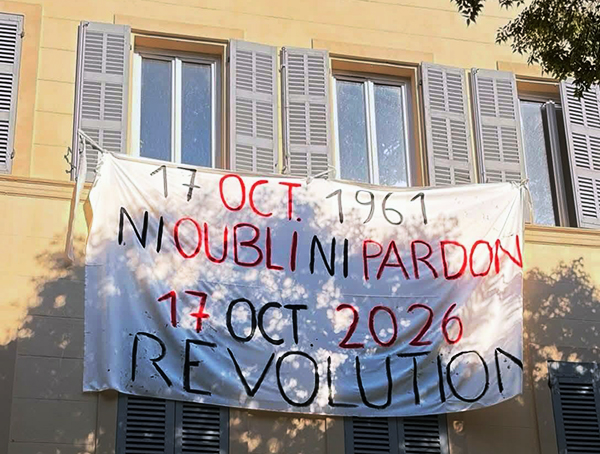
After October the 17th : What Political Outcomes Can we Bring to the Revolt and Riots ?
Statement, October the 25th, 2026
The People’s Rage
Youth have put fire to reactionary France to reject a society they can no longer tolerate.
• A society where the priority is war and militarization, where troops are sent to Saudi Arabia, where there isn’t a penny left for education—or for healthcare, for that matter. Everything for the military, nothing for the youth !
• A racist society where youth from the suburbs is seen only as savages, barbarians, and “rioters” who must be subdued by unlimited force. And on the other hand, they’re trying to enrol them with the November 11 commemoration project… “Honor to our dead,” supposedly ! Yes, the cannon fodder of imperialist conflicts, past and future !
• A class-based society where, year after year, they select those who will be among the lucky few destined to succeed, while the rest are abandoned to their fate as the unemployed or workers. Abolish ParcoursSup and MonMaster, the tools of this class selection !
• A society where violence is everywhere—particularly in education, against young people who are told to shut up and toe the line, against systematic exclusion. But also throughout society : unemployment, precariousness, arduousness working conditions, and flexibility—the working class is the cannon fodder of the globalized economic war. Enough is enough !
• A society where the state believes it can do whatever it wants to repress young people in the most barbaric ways—systematic beatings during police custody, LBD shots, unprovoked tear gas attacks—the cops are running amok, especially in the suburbs. In Aubervilliers, a preschool was tear-gassed !!
The youth are right ! They are breaking the silence of the streets and igniting the flame of rebellion ! We must follow in their footsteps and continue the fight ! “A SPARK CAN SET THE WHOLE PLAIN ON FIRE,” as Mao Zedong said !
They have succeeded in breaking the passivity and powerlessness that were crushing the working class and the social classes.
Faced with the economic crisis, poverty, unemployment, and precarious living conditions ; faced with the budget and debt crises while the bourgeoisie rakes in billions in profits ; faced with the ecological crisis that no one cares about—heat waves, toxic chemicals, agribusiness, water and soil pollution, in the face of the ongoing deterioration of education and healthcare, and in the face of rampant police violence—this accumulation of disasters has produced what was bound to happen : the REVOLT and the RAGE OF THE PEOPLE, with the legitimate violence that such intolerable state violence and arrogance deserve.
WE ARE RIGHT TO REVOLT ! We salute the courage, determination, and remarkable solidarity of the protesters who have come from all walks of life to take on the government and the disastrous effects of its exploitative policies.
No, what we saw were not “hordes of thugs from the suburbs coming to loot and take advantage,” as the right and far right love to claim—a narrative echoed by certain sectors of the petty bourgeoisie, panicked with fear ! What we saw was the anger of the working classes, who are fed up with the harshness of life and the system. Even bourgeois high school students—who weren’t really affected—showed solidarity by coming out to support the suburbs !
The mobilization exceeded all expectations.
We expected 200,000 people in the streets ; there were 800,000—and again on the 24th ! Even the Ministry of the Interior was forced to revise all its figures upward as the day went on, acknowledging that he’d been completely overwhelmed.
• We expected a strong turnout from high school students, and it was there. Notably, unlike in previous movements, vocational high schools were actively involved.
• But they also rallied college students, with most universities and colleges seeing participation.
• They brought out the most determined Yellow Vests—those who never gave up the fight that began in 2018, driven by poverty and the high cost of living. Whether more or less peaceful, more or less radical, these are impoverished working people who immediately “understood” the movement, are not afraid of confrontation, and have been swept up in the wave of “Yellow Vests and youth, all together” !
• They rallied union members to their side, which is a major departure from previous movements, where the unions’ role had not been very clear. This time, we saw a genuine mobilization of militant CGT and SUD activists, in particular, who came to protect young people from police violence.
For now, the organized working class as a whole remains unmobilized, adopting a wait-and-see attitude, frightened by the violence, and still passive. We’ll see what the future holds, with calls for strikes beginning on November 5, after the school break. Austerity measures and growing poverty—set against the shameful billions accumulated by the capitalist and imperialist ruling class—can fan the flames of the uprising ignited by the high school students.
• They rallied the youth from the suburbs—excluded, relegated to substandard high schools, and repressed daily by a racist and violent police force. Raised in a society where the plundering of wealth by the bourgeoisie is the norm, is it any wonder that they came out to fight and confront the authorities, especially since they are quite used to responding to police violence ? Social media has played—and continues to play—an important role in the mobilization, one that is undoubtedly contradictory but nonetheless real.
• They have won widespread sympathy from the working classes, despite the media’s shameful propaganda about looting—aimed at spreading fear and trying to quash the movement. Solidarity has been very strong : parents demonstrating with their children, young people protecting the elderly at protests, and teachers and union members trying to limit police violence.
• The new demonstrations on the 24th showed that the movement is not waning, despite school vacations, despite the lousy weather, and despite the fierce repression.
The reformists may do everything they can to reduce the movement to issues of big money (salaries, school funding) and a better distribution of wealth—issues that are certainly legitimate but do not challenge capitalism—yet this unprecedented mobilization is the rage of the people who have had enough of this system, their anger, and their legitimate violence. This is our side ; this is our struggle ; we are part of it.
Furthermore, the first blockade took place 8,000 kilometers from the Paris region at the end of August, at the Acoua high school in Mayotte. Since then, the revolt has spread to French Guiana, Réunion, and Martinique—and particularly against the high cost of living in Guadeloupe—with the added anti-colonial dimension specific to these territories.
Across Europe and around the world
The government and the media are trying to sell us the idea that this is a revolt by the rabble that must be brutally suppressed, while throwing a few crumbs to the well-meaning, manipulated high school students.
But the revolt is erupting everywhere ! In Spain, it’s the housing crisis and rising rents that are driving the working class into the streets, now joined by youth following the French example. In Germany, it’s opposition to militarization and the return of mandatory military service that is mobilizing the youth. In Albania and Serbia, it’s the fight against corruption. In Italy, youth riots are taking the same turn as in France. In Belgium, Portugal, and Greece, the mobilization is spreading.
In Chile and Latin America, in Bangladesh, in Turkey—everywhere—the youth revolt in France is being viewed with enthusiasm as a symbol of a new manifestation of Gen Z’s resistance against the system and the imperialist order.
Who would have us believe that October 17 is just a minor mood swing stemming from government mismanagement ? A simple matter of wealth distribution ?
The spread of the revolt is proof of the widespread nature of the crisis of capitalism and of the attempts by all the bourgeoisies to make the working class and the people pay for it, while gorging themselves by any means.
At the same time, we are witnessing both the ravages of globalized economic warfare and the rotting of capitalism, which is shamelessly gorging itself in this period of decline in the face of imperialist competitors.
The Failure of a Powerless Bourgeoisie
The government is in dire straits. Caught up itself in the contradictions of an economic, financial, and budgetary crisis, it has run out of immediate solutions and seeks to survive only through the harshest repression, in order to subsequently push through a whole package of anti-popular measures. And by spreading fear through the media it controls, it is pushing for the radicalization of certain sectors of the traditional petty bourgeoisie (shopkeepers, liberal professions) or the salaried class (managers), whom it has been pandering to in the wake of the looting. This is the image of “hordes of suburban scum coming to loot.”
Does this mean, however, that we are in a revolutionary situation, as some seem to think ? No, the repressive apparatus—the army and police, largely co-opted by fascism—is still solid, and the bourgeoisie still has several irons in the fire.
First, the National Rally (RN) scenario—unfortunately the most likely one—an authoritarian, militarized regime, not quite fascism but much harsher than the current system. The neologism “democrature” seems quite fitting, with the support of the imperialist upper bourgeoisie—Bolloré, Stérin—who will obviously be joined by the big bosses of the MEDEF, all too relieved to have social peace restored. Already, the government is allowing a fascist militia to parade through Lyon in the middle of a curfew, while other neo-Nazis attack protesters in Nice, Montpellier, Clermont-Ferrand, and elsewhere without intervening…
Paradoxically, even though the government’s main enemy is the so-called far-left and the LFI, the JLM scenario (if it comes to pass) is also a reformist option for the system’s survival. It is a counterrevolutionary option that will lead the masses into a dead end, unable to reform rotten capitalism amid a general crisis. As many have pointed out, one cannot simultaneously project a revolutionary image and present oneself as a capable future manager of a “humane” form of capitalism… The inevitable eventual failure of such a reformist option will just as inevitably lead to the return of the most hardline factions of the bourgeoisie to government (see Syriza in Greece).
The other political parties (LR, PS, PC, Renaissance, Greens…) are now of little consequence.
Finally, all reactions are tainted by the 2027 election outlook, in which each faction is playing its hand amid a context of economic, social, and political decay.
There is a strong risk that we will once again see a clash between the camp of order and the camp of chaos. The older generation has not forgotten the June 1968 elections—held just after the great general strike—which filled the National Assembly with the uniform “horizon blue” of the most reactionary right…
State Repression
The bourgeoisie therefore has no choice but to resort to the harshest repression. It takes many forms :
– Provocations at demonstrations involving fake rioters and real cops, filmed as they stir up the revolt before taking refuge among the ranks of law enforcement. Chaos must be created to justify maintaining order by any means necessary.
– Ultra-violent repression, including direct fire from LBDs or stun grenades, hands torn off, eyes gouged out, and head injuries. This has even resulted in one death, apparently caused by the high concentration of tear gas. The aim is to instill fear, to literally use the threat of disability—in the literal sense—and stress to put an end to radical mobilizations.
– Torture in police stations and holding cells, with an unprecedented number of people taken into custody, slaps and punches, sexual assaults, racism, systematic violence, insults and harassment, and unspeakable conditions of detention in holding cells—to such an extent that judges are compelled to speak out against them. The goal is to break a generation of politicized high school students who won’t be pushed around.
– Immediate court appearance, assembly-line sentencing, and sentencing recommendations so shameful that judges are forced to temper them. Remember this well : it’s better to beat your wife and children or embezzle millions than to commit shoplifting—that is the lesson the justice system is repeating today. It brings us back to Hugo and La Fontaine : “Depending on whether you are powerful or wretched…”
– We must defend all the accused unconditionally, refuse to ‘separate the wheat from the chaff’, and stand alongside all the victims of government repression !
– The young people from the suburbs who are being arrested are getting younger and younger—13, 14 years old… In working-class suburbs, children and teenagers aren’t recognized as such ; they’re immediately labeled “thugs,” and the police are having a field day.
– Bans on demonstrations in all major cities, buses carrying undocumented immigrants blocked in Orléans, all kinds of obstacles, curfews, attempts to call in the municipal police—and soon the army ?
The government is doing everything it can to crush the movement—to divide, criminalize, and repress without limit. It’s so extreme that even some democrats are outraged.
Yet few are echoing the protesters’ cry of “This can’t go on !”. Reformists prefer to focus on immediate economic demands…
What to make of the looting ?
We won’t gloss over this sensitive issue, which is making headlines across all media outlets in an effort to discredit the movement.
First, let’s be clear : this is a SECONDARY aspect of the mobilization. Let’s not take the wrong side in the face of all the bourgeois or petty-bourgeois interpretations. The MAIN aspect is the People’s Rage and their legitimate anger.
Second, whether we like it or not, vandalism and looting are an integral part of any insurrectionary uprising, of any riot.
We haven’t forgotten the burning of the Brittany Parliament in Rennes by fishermen in 1994. Nor the numerous reactionary acts of violence committed by FNSEA farmers or the agrofascists of the Coordination Rurale.
Marx returns to the subject of riots on several occasions :
“Far from opposing the so-called excesses – instances of popular vengeance against hated individuals or against public buildings with which hateful memories are associated – the workers’ party must not only tolerate these actions but must even give them direction.” Excerpt from the “Address of the Central Committee to the League of Communists”, written by Karl Marx and Friedrich Engels in March 1850.
“The bourgeoisie of the whole world, which looks complacently upon the wholesale massacre after the battle, is convulsed by horror at the desecration of brick and mortar !” Marx, The Civil War in France, 1871.
Marx speaks of public symbols or hated figures. Thus, whether the Limoges city hall burned down or the lobby of the Marseille city hall was ransacked matters little to us. But we note that instances of attacks on symbols of state power—police stations, courthouses, prefectures, city halls—are exceedingly rare ; they were well protected. The protesters’ political consciousness has not yet reached that point.
Similarly, we can understand the attacks on luxury stores, Apple Stores, cell phone shops, sporting goods stores, opticians, and others. They symbolize a consumer society from which the working classes are excluded. Attacking these stores is certainly a sign of alienation, but it is also a response to unbearable exclusion. Fair enough. We have also sometimes seen looters immediately redistribute the spoils of their thefts—everyday necessities—among those around them ; one can, at a stretch, understand the “Robin Hood” logic.
But we cannot condone looting for the sake of looting, as it spread on social media before October 17, which went so far as to physically attack shop owners or customers at small businesses. This is a new development in protests, although we did see waves of cell phones being snatched during the 2006 youth protests against the CPE. So of course, as Politis puts it, “young people are immersed in a world that resembles a vast plundering of the weak by the strong,” where the biggest rioters are those who attack healthcare, education, employment, and housing. Of course, they’ve been left to fend for themselves by all political forces and are reacting as best they can. Of course, they aren’t “intrinsically” thugs who divide the people’s camp, and there’s a whole process of politicization that’s missing.
But there is a red line that must not be crossed in terms of complacent support. We cannot allow the impression to take hold that this is a “revolutionary” revolt aimed at “reclaiming the wealth” that has eluded them. If we allow these attitudes to develop, we risk paying a very high price in the future, with the possible manipulation by self-serving forces of these abandoned and depoliticized sectors.
What are our tasks for today ?
We are living in a period that is not revolutionary, one in which communist forces are very weak, confused, and scattered (and we count ourselves among them). But it is a period in which revolt runs deep and is explosive.
Our main task is not to call for riots and insurrection, even though we must participate in them with all our resources. This is the same stance Marx took at the time regarding the Paris Commune, whose outbreak he considered premature.
The main task is building the party, calling for politicization and organization—first and foremost among the working class, which remains outside the movement despite the genuine mobilization of the most determined unionists. This is where we devote our energies first and foremost. Without a workers’ party, without a vanguard, the uprising and the people’s rage will lead only to repression or a reformist dead end.
Let us not forget that a revolt or an insurrection can be victorious and overthrow a regime or a government, as in Portugal in 1974, in Tunisia and Egypt in 2011, in Sudan in 2019, and in Nepal in 2025. We need a vanguard party to organize the coming insurrections, to serve as their headquarters so that they can survive beyond the seizure of power, just as the Bolshevik Revolution did in 1917.
We call on the revolutionary youth of the proletarian youth in revolt not to cede leadership to the petty-bourgeois youth or to any reformist currents.
We call on the honest and militant activists of the labor movement to coordinate their efforts to chart a course—outside the reformist apparatuses if necessary—and to lead the ideological struggle within workplaces and unions against the racist, pacifist, and legalist prejudices that hinder the formation of class unity.
We call for joining and organizing the emerging anti-fascist movement on a genuine class basis, to avoid continuing down the path of institutional reformism taken in Orléans.
We call for the defense of all those charged, without any discrimination ; they are part of the ongoing movement.
We call for channeling anger and violence, while avoiding all disorderly looting that serves no purpose other than to satisfy an immediate need.
We emphasize the urgency of the situation. It is more than likely that we are heading toward an intensification of repression and reaction on all fronts, with the election of a fascist-leaning leader in the upcoming presidential election.
We are calling out to all former activists who want to return to the fray, to all activists in scattered political circles, to all trade unionists and isolated activists who understand that there is no alternative but the political path : as you know, the LFI is neither a political perspective nor a shield against fascism. So, it is time to put an end to the individualism of scattered protest ; it is time to resume building a truly communist and revolutionary party, rooted in the heart of the working class.
We are counting on the most militant and politically conscious sectors of the people and the proletariat—class-conscious unionists, radical environmentalists, anti-racist and radical feminist activists, and the rebellious youth of the neighborhoods—to join us in forming this Communist Party.